
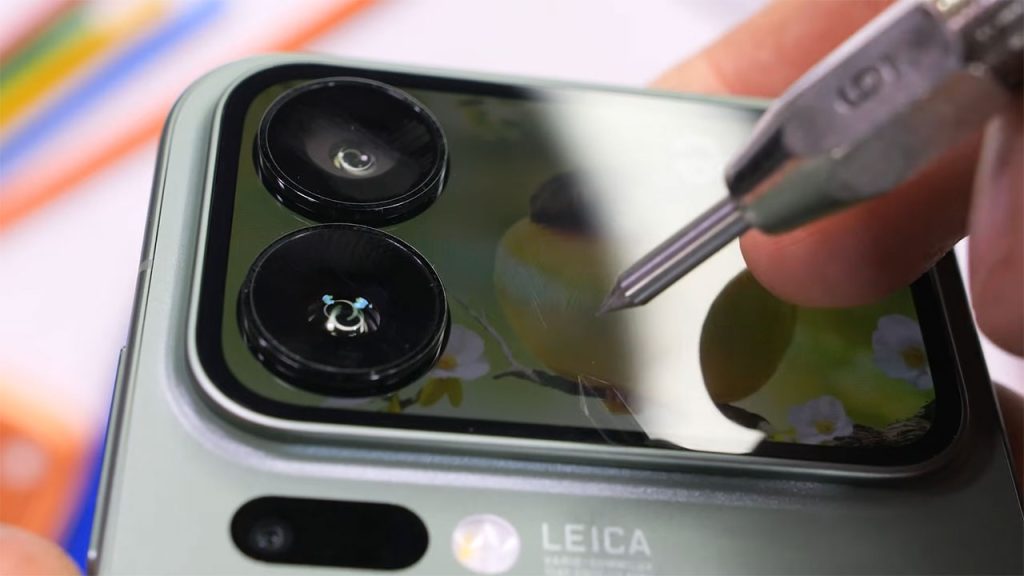
Xiaomi 17 Pro! A flagship that claims to be the most powerful Android right now (at least until the next one comes out!) and shouts from the very beginning that it is a copy of the iPhone 17 Pro. But Xiaomi has done a strange feat in the middle of this copycat; instead of the usual camera island, it has planted a 2.7-inch display on the back that you can use to take selfies or have a virtual pet!
In this article, we want to see if this dragon crystal display is really scratch-resistant? Does it bend under pressure or not? And what’s inside that silicon carbon battery and rear display. Let’s see how tough this alleged Chinese is!
| Component | Specification |
|---|---|
| Display | 12-bit panel (68 billion colors), 2.7″ rear display |
| Protection | Dragon Crystal Glass (Xiaomi Shield 3.0) |
| Cameras | Triple 50MP: Main (OIS), Telephoto 5x (OIS), Ultrawide |
| Front Camera | 50MP punch-hole (no OIS) |
| Processor | Snapdragon 8 Elite (5th gen) with copper vapor chamber cooling |
| Battery | 3,600mAh silicon carbon, 100W wired, 50W wireless charging |
| Build | Plastic back, aluminum frame, IP68 rating |
| Audio | Stereo speakers with acoustic balls |
| Security | Ultrasonic fingerprint sensor |
Display Color Capability Comparison
Durability Test Results
Notable Features & Findings
| Feature | Assessment |
|---|---|
| Rear Display | 2.7″ screen for selfies, notifications, interactive pets |
| Dragon Crystal Glass | Resists Level 6 scratches, some Level 7 marks |
| Rear Display Glass | Regular tempered glass (scratches at Level 6) |
| Build Quality | Survived bend tests with minimal flex |
| Repairability | Easier to open than iPhone but harder screen replacement |
| Heat Resistance | Display unaffected by 25 seconds of lighter heat |
| Water Resistance | IP68 with multiple gaskets and indicators |
Overall Assessment
The Xiaomi 17 Pro successfully combines iPhone-inspired design with genuine innovation, particularly with its functional rear display. While it mimics Apple’s aesthetic, it introduces meaningful improvements in display technology (12-bit color), charging speed (100W wired), and cooling (copper vapor chamber). The Dragon Crystal glass offers superior scratch resistance compared to most Android competitors, though it may not match Apple’s Ceramic Shield. The phone demonstrates solid structural integrity and offers a unique user experience with its interactive rear display features.
Xiaomi 17 Pro Disassembly
With a box that is longer than the opening credits of the Star Wars movie, this Xiaomi 17 Pro is definitely the most powerful and coolest Android phone in the whole world. At least for the next week. Inside the box, they put a 100W charging adapter, a USB-C cable, and even a clear plastic case.
And you might be thinking, how suspiciously similar does this look to the iPhone 17 Pro? And you’re right, but there’s a little twist. Instead of a camera island, there’s a display that I can swipe from the left to activate the cameras. I can swipe from the left to activate the cameras and use the rear cameras for selfies.
There’s a 50MP ultrawide camera that’s not as cool as it might seem to be on an island, then a 50MP main camera up there, and a 50MP telephoto camera with 5x zoom right below that, between the other two lenses. But oh my god, the coolest part is the cute, interactive little animals that get to live on this island. They’re so cute and furry, and I really hope they survive.
Xiaomi has unveiled a new glass called Dragon Crystal or Xiaomi Shield 3.0, which they apparently make in-house. It comes with a pre-installed glass screen protector.
We haven’t tested the Dragon Crystal yet, and I was pleasantly surprised to see that my Level 6 scratches and scuffs didn’t show on it. Level 7 does give some errors, albeit very few. So I don’t think it’s as good as the Corning Ceramic Shield 2 that Apple uses on the iPhone 17 Pro, but Dragon Crystal is definitely better than any other Android phone we’ve seen so far. Xiaomi has cracked it. And if Xiaomi is seeing this, I’d love to see how this glass is made.
There’s also a 50MP punch-hole selfie camera protected by the same Xiaomi Shield 3.0. It sits just below a thin speaker grille that’s glued to the phone’s aluminum frame.
But apart from that, the star of the phone is the rear display. It’s 2.7 inches and the bird interaction is a fun, quirky feature that we haven’t seen in a long time. I’m really happy that Xiaomi has done something new here. On this rear display, we see the lines and scratches of the 6th level and the deeper grooves of the 7th level. So Xiaomi is definitely using regular tempered glass here and not that new dragon crystal.
The 17 Pro’s anodized aluminum buttons are not removable. I like the green color.
The top of the phone has two plastic antenna lines. The left side is empty, just like the iPhone 17 Pro. And on the bottom of the phone we have the SIM tray, the 100W USB-C port, and the bottom stereo speaker. The SIM tray has a black rubber ring around it, which helps with the IP68 water resistance.
When I first picked this phone up, I thought this flagship would have a matte glass back, but it turns out it's plastic. That's great, because now we can make it look even more like the iPhone 17 Pro.
There's nothing wrong with a plastic flagship, of course. I almost prefer plastic, because it's not going to crack or break like glass, which eventually breaks. I think I pulled it off perfectly. No one will notice.
The 50MP main camera on top is protected by glass, as is the telephoto camera. Even the 50MP wide-angle camera down there under the rock is protected by glass. The dual-tone LED flash is covered in plastic.
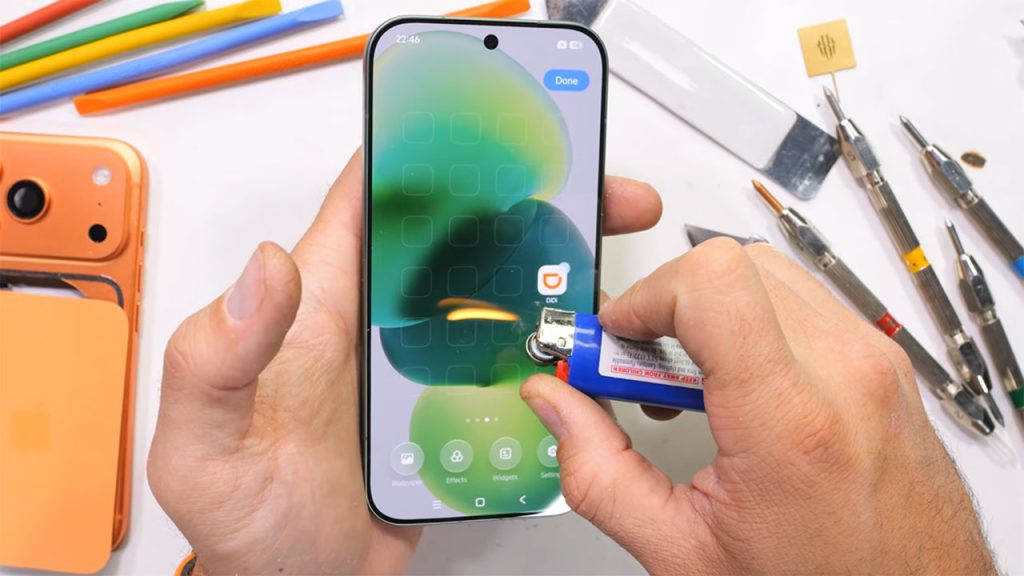
One thing that no one has talked about yet, oddly enough, is the 12-bit display. 12-bit means it can display over 68 billion colors. For comparison, the iPhone 17 Pro can only display 1 billion colors, and the latest Samsung Galaxy S25 Ultra can only display 16 million colors (an 8-bit display instead of 12-bit). This Xiaomi 17 Pro swallows all other phones in terms of the number of colors it can produce. And even after 25 seconds under the heat of my cigarette lighter, it didn't suffer any damage.
There's also an ultrasonic fingerprint sensor under the display, but since the glass is so scratch-resistant, it's clear that it's working perfectly before and after all this abuse.
The real reason we're here, of course, is to see if this king of all phones (at least for this week) is structurally sound. Bending it from the back, Xiaomi seems to be copying Apple’s durability, as there are no bends, creaks, or cracks. Bending it from the front, we see a little flex, but the Xiaomi 17 Pro remains intact.
The 17 Pro survived my durability test, which required us to open it manually to see the silicon-carbon battery inside and its internal cooling system.
But I’m not done yet. The back panel is open, but I noticed a screw that just came loose without me having to remove it. I’ve never had a phone open itself for me before. That’s okay, we all have a few loose screws. But it’s cool to see that the rear display still works, even though it’s not connected to the phone. I’m going to turn off the phone and hope that our bird friend is still here after this is over.
I unscrew a large green square screw from the motherboard and pull the flat cable from the back of the display like a small Lego. Then I unscrew the 11 square screws that hold the wireless charging coil to the battery terminals. This wireless charger may not have magnets around it to hold things, but it can charge at 50 watts, which is crazy. That’s faster than the iPhone’s wired charging.
I remove both battery terminals. These dual cells help the silicon carbon battery charge even faster. 100 watts when plugged in is crazy. The battery says it’s dangerous to open by yourself, but don’t worry, The Force is with me. If you pull up on all three tabs, then pull the top one and then the bottom one, the battery will eventually pop out. But it’s still hard, and I think Xiaomi could have used a little less glue. With a battery technology as cool as silicon carbon, you'd expect it to say silicon carbon somewhere on the battery, but it doesn't. At least not in English.
But here's a side-by-side view of the Xiaomi 17 Pro's 3,600mAh battery versus the 4,252mAh battery inside the iPhone 17 Pro's metal case. Big difference in capacity, small difference in size. Very interesting.
Now that the battery is gone, we can remove the six screws on the bottom speaker. The speaker housing has a little trap door that reveals the balls inside. These balls help make the speaker sound bigger than it is.
I remove the three long flat connectors and remove the charging port board. This is the guy who can charge at 100W. Here's a red rubber ring around the opening to make it water-resistant.
There's more waterproofing on the speaker opening, and two smaller microphone grommets that sit perpendicular to the bottom of the phone. The white hexagonal water damage indicator sticker next to the SIM card tray lets Xiaomi know if your phone has gotten wet just by removing the SIM card tray.
The vibrator is in the bottom right corner and is half the size of the iPhone 17 Pro's vibrator. It's not the size of everything, but the extra length the iPhone's vibrator has allows for more complex and haptic vibration feedback.
I'm putting everything back together, because the goal today is for the patient to still be alive after we put it back together. I miss my bird friend. The motherboard has a few flat cables on the bottom and two more screws on the left that hold it in place. Looking at the 50MP front-facing selfie camera, we see that it doesn't have OIS (optical image stabilization).
The top-facing speaker and stereo speakers are in a metal housing, which is different. Usually it's plastic. But this one has a ball inside. Anyway, now that we’ve filled everything up, the top two cameras want to come out with the motherboard, but the bottom third camera wants to stay in the frame of the phone. You can see that the top 50MP main camera has OIS, as does the 5x telephoto camera. That one also has optical image stabilization. The main camera looks about the same size as the iPhone 17 Pro, but the telephoto sensor is much smaller.
Behind the motherboard is where the thermal paste for the 5th generation Snapdragon 8 Elite is located. This heat is transferred to the outside through a large copper vapor chamber. The 50MP wide-angle camera, which is very small, doesn’t have optical image stabilization. But from this angle, you can see how big the copper vapor chamber is, especially when compared to the iPhone 17 Pro’s vapor chamber that we saw when we unboxed it.
Overall, I’m very impressed. The Xiaomi 17 Pro is much easier to open and close than the iPhone 17 Pro, but replacing the screen on the Xiaomi is much harder, because it's not the first thing you open like the iPhone. Both designs have their pros and cons. But by reattaching that rear screen and turning the whole phone on, our bird friend is still alive and well, and that makes me happy.

