
Samsung made a big promise with the introduction of the A56 phone; 6 years of software updates! Finally, a mid-range that is not going to be obsolete in two years. This phone, which was officially introduced on March 2, 2025, was meant to fill the gap between the S-series flagships and more economical phones and give a premium feel to the mid-range market. But now that months have passed since those days and this phone has been hammered into our and your hands, the story is a little different. That sweet promise has turned into a nightmare in some places.
The story of the A56 is a lesson in a way; the story of how software can elevate or knock great hardware to the throne. In this long-term review, we want to see if the Samsung A56 has turned from that day one hero to a troublesome phone or is it still worth buying.
| Component | Specification | Long-Term Rating |
|---|---|---|
| Display | 6.7″ Super AMOLED, FHD+, 120Hz, 1900 nits peak | |
| Build | Gorilla Glass Victus Plus, aluminum frame, IP67 | |
| Processor | Exynos 1580 | |
| Battery | 5,000mAh, 45W charging | |
| Main Camera | 50MP with OIS | |
| Software | Android 15, One UI 7, 6-year update promise | |
| Speakers | Stereo, bottom-firing without mesh |
Performance Over Time
User Satisfaction by Feature
Major Issues Identified
| Issue | Severity | Impact |
|---|---|---|
| Bootloop Disaster (May 2025) | Bricked devices, lost trust | |
| Camera Image Shifting Bug | Ruined photos in 50MP mode | |
| Forced AI Processing | Over-processed, oily images | |
| Battery Inconsistency | Varies by usage and updates | |
| Speaker Design Flaw | Potential long-term damage | |
| Durability Concerns | Inconsistent drop performance |
Critical Software Problems
Bootloop Nightmare: The May 2025 update (A566BXXU3AYDK) that added Gemini AI access caused endless reboot cycles, effectively bricking devices. Samsung was slow to respond while users found their own fix (removing SIM tray during boot).
Camera Bugs: The 50MP main camera suffers from an image shifting bug in 9:16 aspect ratio, plus forced AI processing that cannot be disabled, resulting in over-processed, unnatural-looking photos.
Verdict: From Promise to Problems
Initial Promise: The A56 launched with premium build quality, excellent display, and unprecedented 6-year update policy – positioning it as the ideal mid-range phone.
Long-Term Reality: Software issues have severely undermined the experience. The bootloop disaster destroyed user trust in the update promise, while camera bugs and inconsistent battery performance have made daily use frustrating.
Bottom Line: The A56 demonstrates how excellent hardware can be compromised by poor software optimization. While the display remains outstanding and performance is adequate for daily tasks, the numerous software problems make it difficult to recommend despite its premium build and long update promise.
Long-term review of the Samsung A56 design
When the A56 first came out of the box, we all said, “Wow!” Samsung had really gone all out and made a phone that felt like a flagship. The back and front panels were made of Gorilla Glass Victus Plus and the frame around it was made of aluminum, which gave it a sense of quality and solidity when you held it in your hand. Compared to its predecessor, the A55, it was both thinner (7.4 mm) and lighter (198 grams), which was a big plus. It was also IP67 certified, which meant you had a lot of peace of mind about water and dust.
Now, how has that glass and metal body held up after a few months? This is where things get a little complicated. While everything looks great on paper, the user experience has been very different. Some people said they dropped the phone a few times without a scratch, but another user reported that his phone fell from a height of 1 meter and the screen completely broke. This means that the durability of this good-looking phone may not be that reliable and depends more on luck than guaranteed build quality. Another user also said that the glass back panel of his phone got a few scratches after just a month of use, which does not match the claimed durability of Gorilla Glass Victus Plus. But there is a bigger and more serious long-term concern that has to do with the speaker design. Instead of using a protective mesh for the bottom speaker, Samsung just left an empty hole. The concern here is that this design allows dust, pocket lint, and even water to easily enter the speaker and degrade the sound quality or even stop the speaker from working altogether over time. While we have not yet reported widespread failures due to this issue, it is a clear design flaw that feels like a time bomb.
Samsung A56 Display Long-Term Review
The display has always been a strong point for Samsung phones, and the A56 is no exception. It’s a large 6.7-inch Super AMOLED panel with FHD+ resolution and a 120Hz refresh rate, and its quality is nothing short of amazing. One of the biggest improvements over the A55 was its screen brightness. The panel’s brightness reached 1213 nits on auto mode, and peaked at 1900 nits outdoors. That means you can use the phone comfortably even in direct sunlight.
Unlike other parts that have had their ups and downs, the A56’s display has held up like a champ, maintaining its quality over time. There have been no widespread reports of quality degradation, brightness reduction, or slow refresh rate over time. That great day-one quality is still there, and this display is still one of the best in its class.
The only long-term concern for any OLED display is the issue of screen burn-in. This happens when a fixed image (like the status bar or navigation buttons) remains on the screen for a long time and its traces are permanently etched. Fortunately, there have been no specific complaints about this issue with the A56. It is interesting to note that Samsung had previously forgotten to include the Burn-in protection feature (which moves pixels) in the One UI 6.0 update for other phones, but later fixed it with another update. This shows how much the software plays a role in the long-term health of the display. It can be concluded that the feature is enabled on the One UI 7 and One UI 8 of the A56 and there is no serious cause for concern. Overall, the A56’s display is the only part that has survived the storm of software problems on this phone. This high-quality display is the mainstay of the user experience of this phone and even with all its other weaknesses, it is still a strong reason for the A56’s appeal.
Samsung A56 Long-Term Battery Life Review
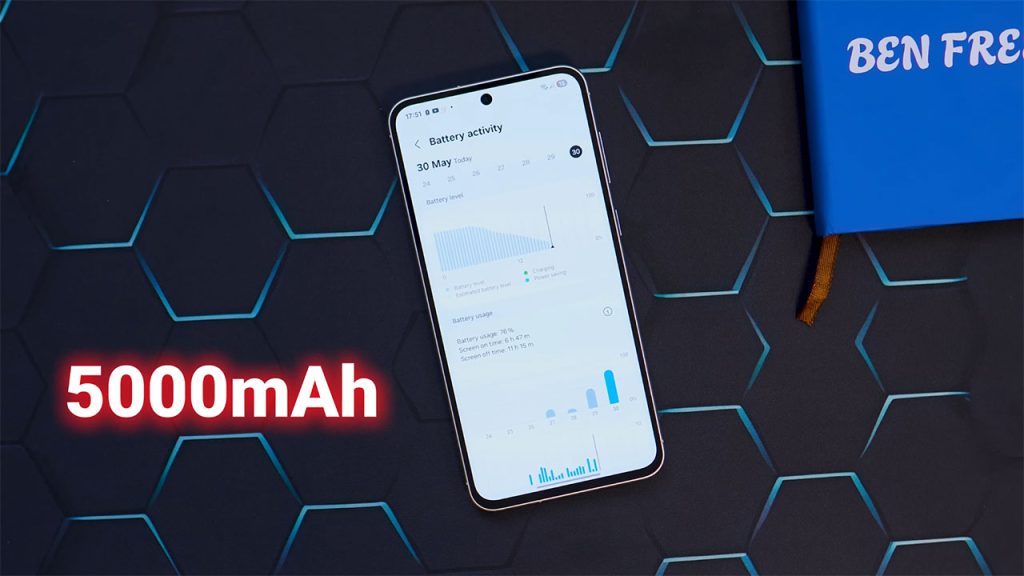
Samsung has used a 5,000mAh battery for the A56, which is the same capacity as the A55. The good news is that the charging speed has been upgraded to 45W, which is a significant improvement over the 25W of the previous generation. Lab tests showed that the phone could charge to 65% in 30 minutes, although a full charge took about 1 hour and 13 minutes.
But the strange thing is that early tests showed that the A56’s battery life was even slightly less than the A55’s due to the more powerful processor and larger screen. The active usage score of this phone was 12 hours and 8 minutes, while the A55 recorded a score of 13 hours and 27 minutes. This means that the A56 was an average phone from the start, not a champion in the battery department.
If we were to describe the A56’s battery life in the long term, we would have to say it was completely unpredictable! User experiences and feedback are completely different. On the one hand, many people complain about the rapid battery drain. One user even reported that after an update, his phone was losing 1% of its charge every hour, even in standby mode.
On the other hand, others are completely satisfied with the battery and say that it easily lasts a full day and even up to two days with normal use. Where does all this difference come from? The answer lies in Samsung’s software. This phone has a feature called Adaptive Battery, which takes a few days to a few weeks to learn your usage patterns and optimize the battery. That’s why many users are unhappy with the battery in the first few days, but after a while the situation improves.
In addition, it seems that some software updates are not well optimized and have increased battery consumption for some users. Now that the One UI 8 (Android 16) update has arrived, everyone is waiting to see if the battery situation will get better or worse.
So, there’s no general rule about the A56’s battery. Its performance is not constant and depends heavily on the software version, your usage pattern, and whether it has gone through the learning curve. In this section, we can say that it performs well, but it may vary over a period of time and depending on the type and version of One UI you have.
Long-term camera performance review of the Samsung A56
Samsung didn’t bother much with the A56’s camera hardware, repeating almost the same combination as the A55; a 50-megapixel main sensor with optical image stabilization (OIS), a 12-megapixel ultrawide camera, and a 5-megapixel macro sensor. The only change was the selfie camera, which changed from the 32-megapixel sensor on the A55 to a new 12-megapixel sensor. The main camera took good photos in daylight, but the lack of a telephoto lens for optical zoom was a major weakness, and the quality of photos in low light was quite average.
This is where the A56’s story takes a sharp and dark turn. Camera software issues have become so common and annoying over time that they have severely affected the user experience.
Image Shifting Bug
One of the most serious and widely documented issues with this phone is a strange bug in the 50MP main camera. When you take a photo in a 9:16 aspect ratio, the image that is saved is shifted to the left of what you see in the viewfinder.
- When does it happen? This problem only occurs in 50MP mode and in a 9:16 aspect ratio or full screen. This bug is especially noticeable in bright light, such as on a sunny day, and does not occur in low light.
What is the cause? This seems to be a software bug that was added to the phone with one of the updates, as some users said that this problem did not exist in earlier versions of the firmware. Disabling the Scene Optimizer option can be a solution to some extent, but it may not work for everyone.
Intrusive and Forced AI Processing
Another issue is the over-processing of photos by AI. According to various user feedback, a photo they take will look great in the preview for a few seconds, but then a heavy, automatic processing will be applied and ruin the photo. The result is usually an oily, watercolored, or over-processed image. The disastrous thing is that this feature cannot be turned off.
Along with these major issues, there have been reports of smaller issues, such as yellowing of photos in night mode, which can of course be fixed with a software update. While everyday photos perform satisfactorily, these technical issues have made the A56’s photography experience worse rather than better over time.
The A56’s camera is a classic example of how the potential of good hardware can be destroyed by poor software. The user experience of this camera has clearly declined since its launch, not because of aging sensors, but because of software bugs and forced, annoying features.
Long-term review of the Samsung A56 hardware and software
A56 hardware
The beating heart of the A56 is Samsung’s own Exynos 1580 processor. It was clear from day one what kind of processor we were dealing with. Benchmark tests showed that it was a good improvement over the Exynos 1480 in the A55. The tests also confirmed that it was quite smooth and suitable for everyday tasks such as browsing the web, scrolling through social networks and watching movies. But if you were a fan of heavy games like Fortnite, the phone would lag and the game would run with severe lag and frame drops.
The same situation was maintained in the long term. The phone is still fast and smooth for normal use, but it is not a gaming giant. Fortunately, there are no widespread reports of the phone slowing down over time and it seems that the Exynos 1580 was able to provide stable, albeit not very exciting, performance.
A56 Software
And now we come to the most dramatic part of the A56 story; where its greatest strength turned into its biggest nightmare. Samsung launched the A56 with Android 15 and One UI 7, promising 6 years of OS and security updates until 2031. That’s flagship-level support for a mid-range phone, which was unprecedented until then.
The Bootloop Nightmare
The real crisis began in May 2025, after the release of a special update for One UI 7 (build number A566BXXU3AYDK). This update, which was supposed to add quick access to Google’s Gemini AI to the power button, caused a large number of A56 phones to get stuck in an endless reboot loop and practically turn into a brick.
- What was the cause? It was directly related to the Gemini update.
- What were the symptoms? The phone would get stuck on the boot screen with those spinning gears and wouldn’t boot up. A soft reset and even a hard reset didn’t work.
- Unofficial solution: While Samsung remained silent, users found a solution on the forums themselves; turn off the phone, remove the SIM card tray, and turn it back on. This was the only way out for many.
- Official response: Samsung acknowledged the problem too late and after a lot of fuss.
This disaster was a huge blow to users’ trust. The promise that was supposed to be the main reason for buying this phone turned out to be the main reason for their troubles. Now the phone has started receiving the Android 16 (One UI 8) update, but the bitter memory of the boot loop has made many people press the update button with fear and trembling. This incident showed that the promise of long-term updates without careful quality control can act like a double-edged sword.
Long-term review of the A56 speaker
The A56 came with stereo speakers that combined a top-firing speaker and a bottom-firing speaker. We were pleased with the sound quality in our initial reviews. Overall, the sound quality was quite acceptable for a mid-range phone.
The main concern, as we mentioned in the design section, is the physical design of the speaker. That empty hole without a protective mesh is a potential long-term weakness. Dust and lint buildup in the speakers is one of the main reasons for muffled and degraded sound quality in phones. While we haven’t yet seen any direct reports of speaker failure due to this design, it’s an engineering flaw that greatly increases the likelihood of sound quality degradation over the phone’s 6-year lifespan.
Is the A56 still worth buying?
The story of the Samsung A56 is one full of contradictions. On one hand, we have a phone with a great display that still reigns supreme and a dreamy update policy that looks great on paper. On the other hand, the same update policy has destroyed user trust with a software disaster like a bootloop, and a camera that has become increasingly worse due to software bugs and forced processing.
To sum up, the enduring strengths of this phone are its excellent display and smooth performance for everyday tasks. On the other hand, the weaknesses that have shown themselves over time are the bootloop disaster and software issues in some cases, the camera with various and annoying bugs, an unreliable battery, and a design with potential weaknesses.

