
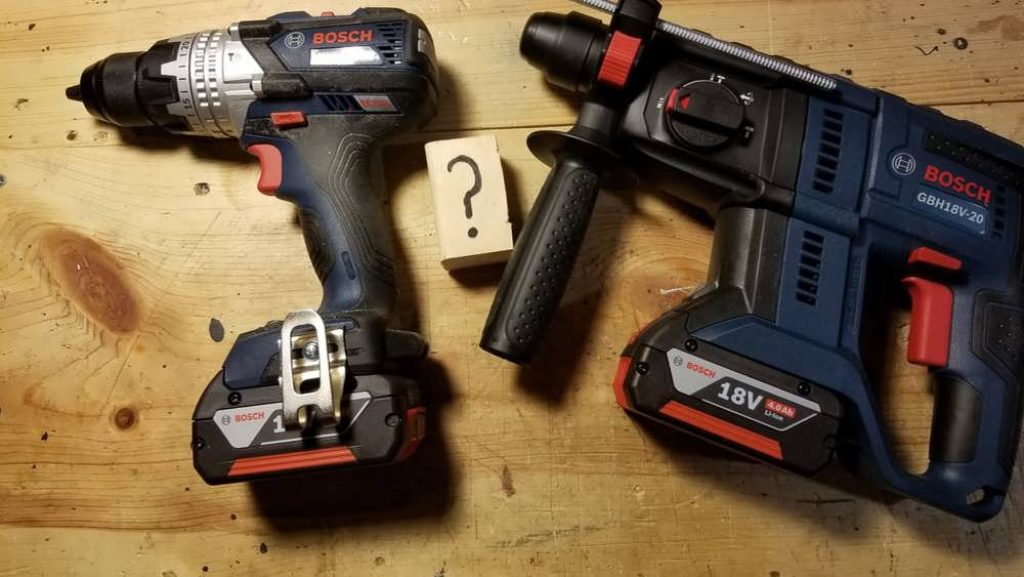
A hammer drill functions like a hammer or rotary drill with rotary blows. A hammer drill is used to drill hard surfaces such as concrete, cement, and stone. The hammering action of this tool breaks and crushes hard materials with rapid and continuous blows of the hammer, and drilling is done with less effort and faster. Hammer drills have a special clutch that, in addition to rotating the gears, connects them in and out. In a hammer drill, in addition to rotating around its axis, the drill is also hitting the drill as if it is driving the drill forward.
The impact and hammering action in a hammer drill occurs very quickly, at about three thousand revolutions per minute. Each blow by a hammer drill has a relatively small force, but because the number of blows is high and exceeds three thousand revolutions per minute, a hammer drill works much faster than a gear drill to break hard surfaces such as brick or cement. The ability to hammer and strike increases the speed of the drilling process, so this hammer is used to drill concrete or hard surfaces with very high thickness. A hammer drill is one of the most practical and widely used types of drills.
A gear drill is another type of drill. This type of drill has a gear that mainly has two modes to increase power or reduce speed. In a gear drill, the drill rotates continuously around its longitudinal axis. A gear drill is designed to open and close long and large screws, tap and drill holes in hard surfaces such as concrete, stone, plaster and cement, etc. Tightening strong screws for the base of wall cabinets is also another use of a gear drill.
Although other types of drills can do these things, they may encounter problems during use due to the lower power of the device, such as breaking or bending the drill, twisting and loosening the screws, etc. Excessive pressure on the drill can cause burning or reduce the life of the device. Geared drills are more powerful than screwdriver drills. Geared drills easily loosen screws tightened in tight environments and holes by applying more rotational force.
The drill diameter in hammer drills is 13 mm for steel, 30 mm for wood, and 16 mm for concrete. Hammer drills can be adjusted to two modes: simple and hammer. On hard and thick surfaces, by setting it to hammer mode, the desired surface can be drilled with hammer blows. If you plan to use the drill for demolition, it is better to use a hammer drill.(Top10 Hammer Drills for Home Improvement Projects)


Difference between drills and hammer drills:
The main difference between drills and hammer drills is the type of drills. In hammer drills, the three-jaw system is designed in such a way that both round and six-head drills can be connected to it. The three-jaw systems available on the market all have three separate jaws.
There are two types of three-jaw systems:
Wrench and automatic. Automatic three-jaw systems are used for home use and in lower forces, and wrench-type three-jaw systems are used in workshop use for heavy drilling.
But in the drill, there is a locking socket that only six-head drills can be connected to it. The drills have smaller sizes and dimensions than hammer drills. In this type of drill, there are no thick and large three-jaw systems. Therefore, controlling gear drills in tight spaces is easier and more accurate than hammer drills.
To solve this problem, new models of hammer drills have two hammer and normal modes. By adjusting, the hammer drill type can be changed to a box type and used with more precision. In new hammer drills, the ability to adjust the drill rotation speed and adjust the hammer mode is one of the special advantages of these drills.
Using a drill for a long time is not tiring like a hammer drill; because the force is applied in the drill in a rotational manner and therefore the force is not felt in the wrist or hand like a hammer drill. If the work is light and the possibility of converting the box is available, hammer drills can be converted into a box wrench.
Hammer drills have the ability to automatically screw wood and MDF. Both types of drills have cordless and electric types, so when buying cordless devices, pay attention to the power of the device.
Choosing the Perfect Power Drill: A Comprehensive Guide to the Top 5 Models
The most important questions from users
1-Which one should I buy for home and regular tasks (tasks needed at home)?
Answer: A regular (electric) drill is enough
2-If I were to buy only one drill, which one should I choose?
Answer: A hammer drill is versatile because:
Regular drill mode: for wood and metal.
Hammer mode: for concrete and stone.
Screwdriver mode: for screwing and unscrewing screws.
3-When should I definitely use a hammer drill?
Answer: When you plan to drill holes in cement, concrete or stone walls. Walls that are solid

